Your API Bill Became a Line Item: Renting vs Owning Intelligence
There's a moment in every AI product's life when the API bill stops being a rounding error and starts getting its own line in the management accounts. Someone in finance asks what it will be next quarter, and the plain answer is: nobody knows, because it's priced per token and the product is growing.
That moment is not an emergency. It is, however, the right moment to do the renting-versus-owning maths properly — because both the panic response ("we must self-host immediately") and the default response ("it's fine, it's opex") are usually wrong.
Why per-token pricing feels fine until it doesn't
Per-token billing is a brilliant deal at the start: zero capital, zero ops, frontier quality on day one. The catch is structural — your cost scales linearly with your success, and you don't control the price. Providers reprice, deprecate models, and shift rate limits on their schedule, not yours. Renting is flexibility you pay for precisely when you can least avoid paying it: when usage is up.
Owning inverts the deal. The costs are front-loaded, lumpy and partly hidden — hardware, the 2.5–3× infrastructure multiplier, real engineering hours every month — but the marginal token is nearly free, and the bill next quarter is the bill this quarter.
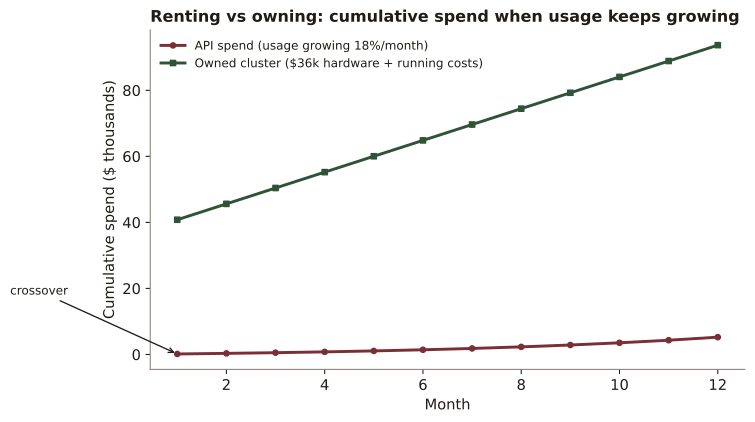
Worked model: usage starting at 1M tokens/day growing 18% a month against a blended $5/1M frontier rate, versus a published $36k single-node build plus running costs. Illustrative — the shape is the point, not the exact crossover month.
The shape is what matters: the API line curves, the owned line is straight. If your usage is flat, the lines may never cross and renting wins indefinitely. If usage compounds, the crossover isn't a question of if but when — and every month past it is margin you're donating.
What fully-utilised ownership actually buys
At full utilisation, owned inference is dramatically cheaper per token. The published worked examples land around $0.40 per million tokens all-in for a well-run single node; vendor analyses claim owned clusters run 8–18× cheaper than equivalent cloud over multi-year horizons — treat that range as marketing-adjacent, but the direction is real.
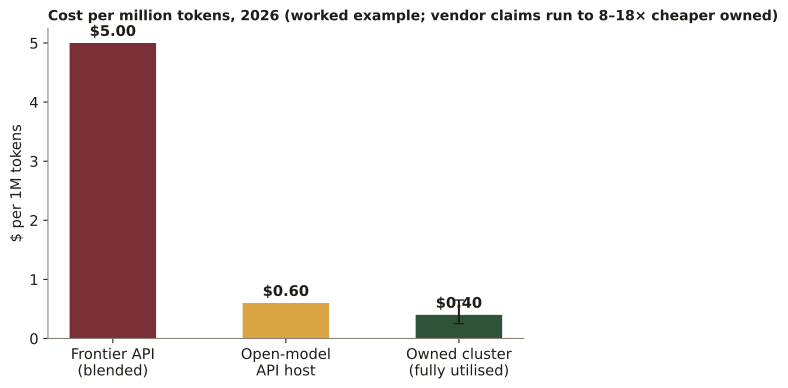
Worked example rates; the 8–18× figure is vendor-claimed (Accrets, 2026) and labelled accordingly.
Before you buy a rack, do the cheap things
Owning is the last lever, not the first. In cost order: cache aggressively (identical prompts should never hit the model twice); route by difficulty — a frontier model summarising delivery notes is a Bentley doing the school run, and open-weight models behind an open-model API host cost cents on the frontier dollar for defined tasks; trim your prompts, because system-prompt bloat is billed per call; and batch anything that isn't interactive. We have seen these four cut bills by more than half before any hardware conversation was worth having.
If after that your curve still looks like the red line, you're a genuine ownership candidate.
The predictability argument
One more thing renting can't give you, at any price: a fixed number. For some boards — especially where AI spend is being capitalised into a product's unit economics — cost predictability is worth more than cost minimisation. An owned cluster is a known quantity: depreciation, power, a maintenance contract. That's a sentence a CFO can put in a forecast. "It depends on usage and the provider's pricing page" is not.
The straight answer, priced
Our readiness assessment is a fixed-fee engagement and produces the decision with your numbers in it: your volume curve, your caching and routing headroom, your break-even month if one exists, and a module-by-module spec if ownership is justified — or a written "stay on the API and do these four things instead" if it isn't. Either way the CFO gets a number.
[Book a consultation →](/book) — a 30-minute call, no specs required.
Sources - SitePoint — Local LLMs vs Cloud APIs: 2026 TCO Analysis - DevTk.AI — Self-Host LLM vs API: Real Cost Breakdown 2026 ($0.40/1M worked example) - Accrets — Executive Playbook to On-Premise LLM Deployment 2026 (8–18× owned-cluster claim — vendor figure) - AI Pricing Master — Self-Hosting vs API Pricing: Complete Cost Analysis 2026
Charts are worked models from the sourced figures; rerun with your own volumes.