Private LLM vs API: Where the Break-Even Actually Sits in 2026
Everyone selling private LLM deployments has a slide showing how much cheaper it is than the API. We sell private LLM deployments, and we're telling you: for most teams, at most volumes, the API is cheaper. The interesting question is where that stops being true — because when it flips, it flips hard.
Here is the maths as it stands in 2026, with the assumptions on the table where you can check them.
The one number that decides most of it
Break-even between renting and owning is almost entirely a function of how many tokens you push through the model per day, sustained — not at your peak, not in your demo week. The 2026 analyses cluster around the same band: self-hosting starts to beat frontier closed-model APIs at roughly 2–5 million tokens a day. Against open-model API hosts — the Together-AI-shaped providers serving Llama and Qwen by the token — the break-even moves out to 50 million tokens a day or more, because those hosts have already squeezed the margin out of serving open weights at scale.
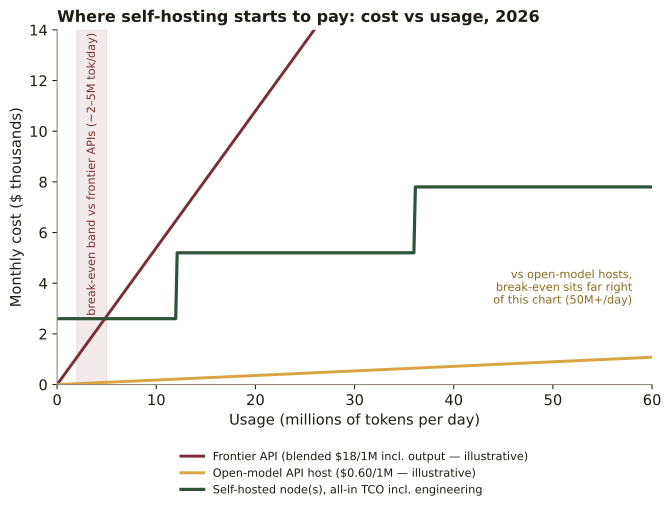
Worked model using an $18/1M blended frontier rate (input + output tokens, illustrative) and $0.60/1M open-host rate; self-hosted line is all-in node TCO including engineering, stepping as capacity is added. Break-even bands per SitePoint and DevTk 2026 analyses — sources at the end.
Read that chart plainly and two things follow. If your bill is being generated by a frontier model doing routine extraction, classification or summarisation, you may be in break-even territory sooner than you think. If your usage is modest and bursty, self-hosting is a hobby with an invoice.
What "total cost" actually totals
The GPU price is the number people quote and the smallest part of the story. A defensible 2026 rule of thumb: multiply the hardware cost by 2.5–3× once power, hosting, networking and redundancy arrive, then add the line item nobody budgets: 10–20 hours of senior engineering a month — patching inference servers, chasing driver regressions, re-testing after model updates. At $75–150 an hour that is $750–$3,000 a month, forever.
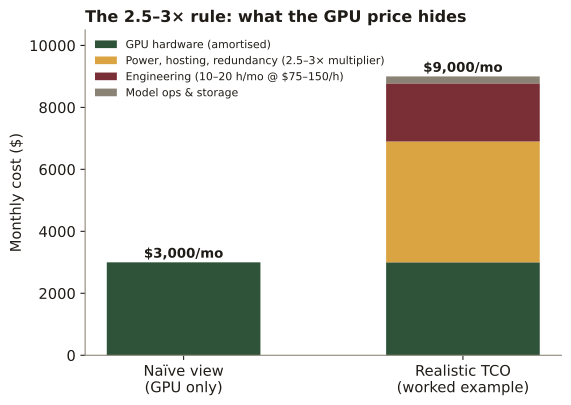
Mid-point worked example. One published single-node build: ~$36,000 hardware reaching ~$5,931/month all-in TCO, ~$0.40 per 1M tokens at full utilisation, breaking even against a frontier API in 6–7 months — at the right volume.
The phrase doing the heavy lifting there is at full utilisation. An owned cluster serving tokens around the clock is the cheapest inference you can buy. An owned cluster idling between business hours is a space heater with a depreciation schedule.
When the API is the right answer
We would rather tell you this before you spend anything: rent the API if your volume is under a couple of million tokens a day; if your workload spikes rather than hums; if you have no one whose actual job is to keep inference infrastructure alive; or if your use case still needs frontier-model quality that open weights can't yet match against your acceptance criteria. The 2026 consensus is blunt — for the majority of teams, API access wins once the full cost picture is counted.
When owning starts to win
Three situations reliably cross the line. Sustained volume — you're past the band on the chart and still growing. Sovereignty — your data legally or contractually can't transit a third-party API, at which point the break-even maths is irrelevant because renting was never on the menu (we've written about that separately). Predictability — the CFO wants a number that doesn't move when a provider reprices, which owned hardware gives you and per-token billing never will.
The plain way to decide
Don't decide from a blog post, including this one. The inputs that matter — your real token volume, your latency needs, your data constraints, your engineering capacity — are measurable, and the decision falls out of the measurement. That's exactly what our private LLM readiness assessment is: a fixed fee, your numbers, and a straight answer — including "don't do this, stay on the API" when that's what the numbers say. It has said that before.
[Book a consultation →](/book) — a 30-minute call first.
Sources - SitePoint — Local LLMs vs Cloud APIs: 2026 TCO Analysis (break-even bands, API-wins-for-most conclusion) - SitePoint — Self-Hosted LLM Costs 2026 (2.5–3× infrastructure multiplier, engineering hours) - DevTk.AI — Self-Host LLM vs API: Real Cost Breakdown 2026 (worked $36k / $5,931-month / $0.40 per 1M example) - Alpacked — Self-Hosted LLM Guide: Costs, Architecture & Breakeven
Charts are worked models built from the sourced figures above; illustrative rates are labelled as such. Rerun them with your own numbers before deciding anything.