Open-Weight Models Are Good Enough Now: Llama, Mistral and Qwen in Production
For two years the safe advice was: prototype on whatever you like, but production runs on a frontier API. In 2026 that advice is stale. Open-weight models — the ones whose weights you can download and run inside your own walls — now pass real acceptance criteria for a large share of real workloads. Not all of them. The interesting skill is knowing which.
The stock and the flow
The deployed base still belongs to closed models: roughly 87% of enterprise LLM workloads run on closed-source today. But the direction of travel is unambiguous — 41% of organisations plan to expand open-source deployment, and the regulated sectors drove a 40% jump in on-premise hosting in a single year.
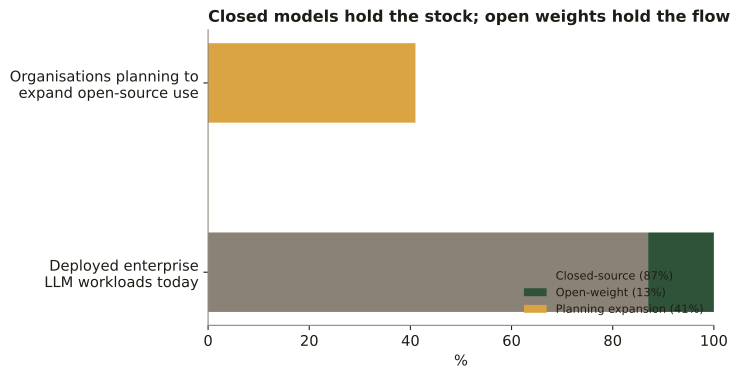
Sources: DreamFactory statistics roundup, 2026. "Planning expansion" is stated intention.
Closed models hold the stock; open weights hold the flow. That's what "good enough now" looks like in market data.
Who's who, without the leaderboard theatre
Benchmarks age badly and leaderboard positions churn monthly, so treat this as a map of temperaments rather than a ranking. Llama (Meta) is the default general-purpose choice — the biggest ecosystem, the most tooling, the easiest hiring story. Mistral is the efficiency-and-Europe play: strong models at sizes that fit sensible hardware, Apache 2.0 licensing, European languages handled properly, and for EU organisations the sovereignty argument comes free. Qwen (Alibaba) is the multilingual workhorse with strong coding variants and aggressive small-model releases. Around them: DeepSeek for code-heavy work and Phi and Gemma for when small-and-cheap beats big-and-idle.
| Family | Licence posture | Where it earns its keep | Watch out for |
|---|---|---|---|
| Llama 4.x | Open weights, Meta licence terms | General reasoning, ecosystem breadth | Licence isn't Apache — read it |
| Mistral (incl. Large 3) | Apache 2.0 on open releases | Efficiency, EU languages, sovereignty | Top-end sizes need real hardware |
| Qwen 2.5+ | Open weights | Multilingual, coding variants | Provenance questions in some procurement contexts |
| DeepSeek | Open weights | Code generation/review | Same procurement caveat |
| Phi / Gemma | Open weights | Small, cheap, defined tasks | Not for open-ended reasoning |
Model versions current mid-2026; verify against the publishers' pages the week you decide — this table will age.
What "good enough" actually means
Here's the part the model cards won't settle. "Good enough" is not a benchmark score — it's a sentence with your name in it: this model passes our acceptance criteria, on our data, for this defined task. A model that scores three points lower on MMLU and passes 100% of your extraction test set is good enough. A frontier model that aces the leaderboard and hallucinates one client name per thousand documents is not.
This is why we won't deploy a private model without a written spec. Acceptance criteria first — accuracy thresholds on your own test set, latency budgets, failure behaviour — then the model choice falls out of the evidence. It's the same spec-first method we use for production builds, applied to model selection. Opinions about models are cheap; eval runs against your data settle the argument.
The catch: open weights are a relationship, not a purchase
The publishers retire and replace models on their own schedule, and "just stay on the old version" stops being an option the day a security patch or a licence change lands. A production deployment of open weights needs the same discipline as any other production system: pinned versions, eval runs on every candidate upgrade, and a rollback path. That ongoing discipline — model migrations on the publisher's schedule, evals on every change, a monthly report — is exactly what our Maintain service covers. Deploy without it and you've built technical debt with a GPU attached.
The decision, in one plain paragraph
If your task is defined, your data is yours, and your acceptance criteria are written down, there is a good chance an open-weight model passes them in 2026 — at a fraction of frontier per-token cost and with your data inside your walls. If your workload is open-ended, frontier-dependent, or too small to justify infrastructure, rent the best model you can and revisit in six months. Our readiness assessment, at a fixed fee, runs your actual evals and gives you the answer in writing, whichever way it lands.
[Book a consultation →](/book) — a 30-minute call first.